The power of software developers

I am a retiree from the Boomers generation working with a group of software developers. They set up a Facebook group, WordPress blog, Google Slides … in lightning speed. Ideas are shared “in low band width” (Fernandez) more than face-to-face. Ivy used state-of-the-Art techniques to shoot the video, fully coordinated with superb music selection. May was able to combine multiple screens using advanced editing software. After our presentation, I received compliments from a fellow classmate that our video was very “artistic”. During our online group discussions, I was particularly impressed by a Kristen’s thoughts on how to convey the concept of AI. Despite Asimov’s conceptual laws to protect humans from AI (40), there is still a certain degree of uncertainty. I adopted Kristen’s idea of expressing the uncertainly of AI via a picture. The picture was posted on our group blog. This group of software developers seem to be in a perpetual transient mode. While attending class on campus on one day, they can be in California doing co-op jobs on the next day. Their physical locations appear unimportant.

In fact, physical locations no longer play a key role in digital lives, even in battlefields. In WWI and WWII, technological innovation of sophisticated machines resulted in the destruction of human lives (Fernandez). Today, one of the latest technological innovation is digital attacks on the enemy’s utility system. Cyberwarfare becomes part of digital lives. Russia was able to cripple Estonia’s government, banking, and national media websites in 2007 (Orend). More recently, the New York Times reported that the US will escalate its online attack to Russia’s power grid system. US President Trump had granted more flexibility to the Cyber Command to launch offensive cyber strikes without presidential approval (Sanger and Perlroth). The US has evidence that Moscow has already planted malware in the US utility systems (Ranger).

The role of software is vital on cyberwarfare. With this latest development in armed conflicts, a country can attack the target state half a world away by planting some malware in the enemy’s utility system. Will our software developers become war heroes one day?

Abbie Ho 20701760

Works Cited

Asimov, Issac. “Runaround.” I, Robot. New York City: Doubleday, 1950. p.40.

Fernandez, Stephen. “Digital Lives and the Sense of (Not) Belonging”, University of Waterloo, Waterloo, Ontario, 13 May 2019. Lecture.

Fernandez, Stephen. “The Impact of Media and Technology”, University of Waterloo, Waterloo, Ontario, 15 May 2019. Lecture.

Orend, Brian. “Armed conflict”. Introduction to international studies. Oxford University Press, 2019.

Ranger, S. “Cyberwarfare escalation just took a new and dangerous turn.” ZDNet, 18 Jun 2019, https://www.zdnet.com/article/cyberwarfare-escalation-just-took-a-new-and-dangerous-turn/.

Sanger, D. and Perlroth, N.  (2019, Jun 15). “U.S. Escalates Online Attacks on Russia’s Power Grid.” The New York Times, 15 Jun 2019, https://www.nytimes.com/2019/06/15/us/politics/trump-cyber-russia-grid.html?action=click&module=RelatedCoverage&pgtype=Article&region=Footer

SNS Auto Recommendations – opening minds or restricting thoughts?

In our video, we use twitter to represent digital communities. When Alice has a downtime, she becomes a digital resident to gain acceptance from digital living. Social network builds a bridge to connect people from the whole world. it becomes possible to gain information about residents from different countries. With social network service, it become easier to find people sharing the similar interests. We could say that social communities make people open-minded and more connected. In our video, Alice is more comfortable to connect with her twitter friends, and finally she falls asleep with smile. 

As big data is introduced, social network services apply this concept in their app to recommend related users and tweets. It is much easier to find interested contents in social network app. The recommendation feature does save the users many time to search for contents and meet similar friends, but it also narrows down the information users can collect. Before the eve of big data, people always perform searchings, and read different opinions frequently. After recommendation service is added, users can gather enough information from their homepage (from followers sharing similar opinions and auto-recommendations), and thus perform less searching behaviours. This phenomenon hides various information, and somehow restricts people’s thoughts. 

People believe the information they want to view on social network is selected by theirselves; however, the fact is, those information is still controlled by algorithms. Still, we have no control over our digital livings.

Yining Wang 20614744

Language without Words – Scene Settings

I was working on the storyboard of the video. One of the important parts of the video is the background settings. We want to create an environment to imply the “downtime” theme. Since the video is very short (about one minute and a half), one proper background is necessary. Background settings are the language without any words, but they could carry out some meanings and thoughts.

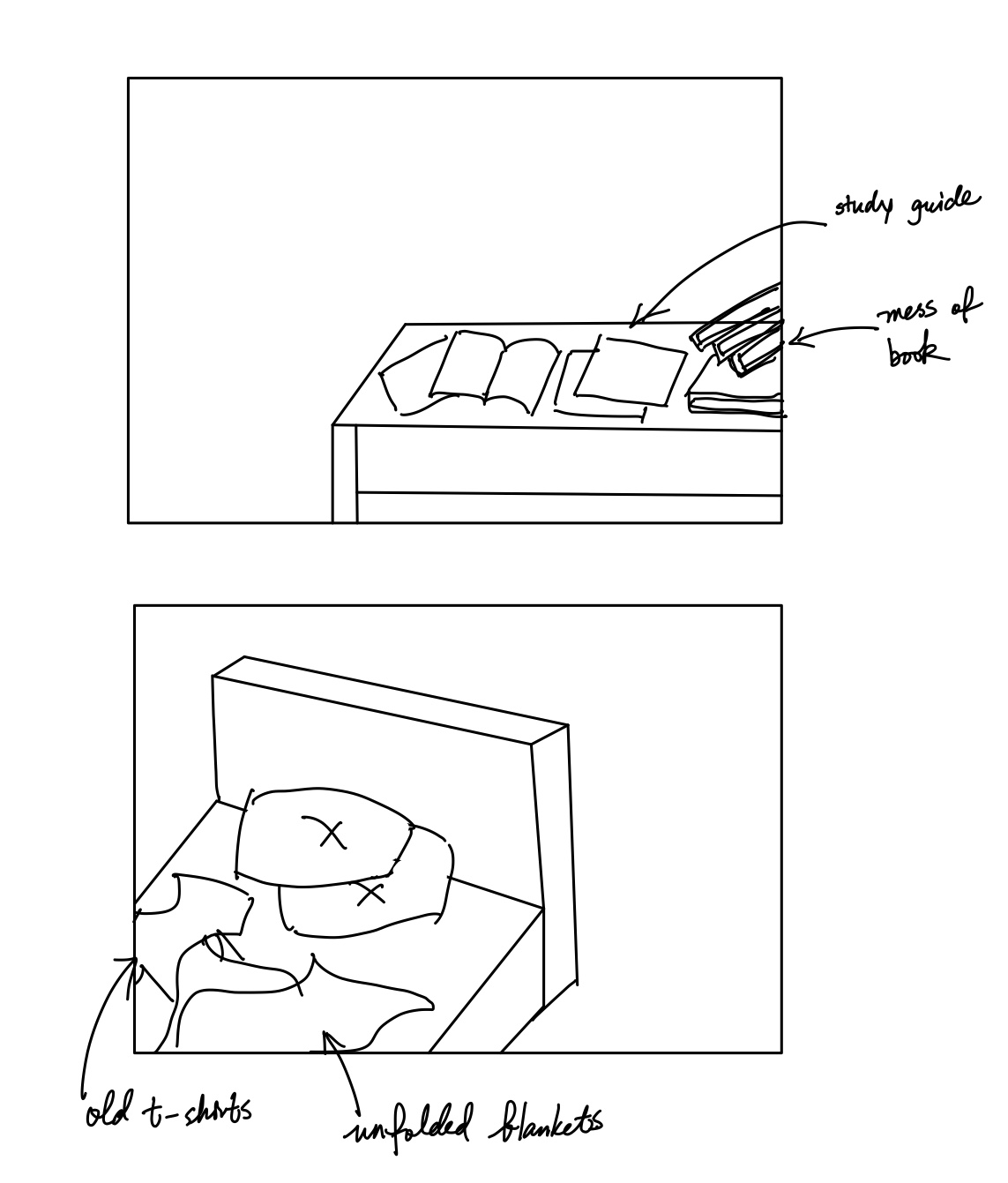
When people are having downtime, they tend to appear as a tired, despondent image. The first thought comes to mind is to escape home and lay on the bed.  Beds create a comfort zone for individuals; it is warm and soft, like the hug of mom. Most scenes of our video happen on the bed. Laying on the bed also represents the escape from society.

We would like to use the background environment to imply despondent emotion. The mess would be the common way to hint the downtime. There are two major areas in the video: the desk and the bed. Since Alice is still a student, we display the study guides on the desk and cover the surface disorderly. There is an opened book using to tell Alice is now facing some problems caused by school. Unfolded blankets on the bed imply that those problems bother Alice for a long time, that is, she has no extra energy to fold those blankets before going to school. The mess of bed and desk represents the exhaustion in real life, and explain the reason for escaping from real life and hiding into the digital community.

Yining Wang 20614744