The power of software developers

I am a retiree from the Boomers generation working with a group of software developers. They set up a Facebook group, WordPress blog, Google Slides … in lightning speed. Ideas are shared “in low band width” (Fernandez) more than face-to-face. Ivy used state-of-the-Art techniques to shoot the video, fully coordinated with superb music selection. May was able to combine multiple screens using advanced editing software. After our presentation, I received compliments from a fellow classmate that our video was very “artistic”. During our online group discussions, I was particularly impressed by a Kristen’s thoughts on how to convey the concept of AI. Despite Asimov’s conceptual laws to protect humans from AI (40), there is still a certain degree of uncertainty. I adopted Kristen’s idea of expressing the uncertainly of AI via a picture. The picture was posted on our group blog. This group of software developers seem to be in a perpetual transient mode. While attending class on campus on one day, they can be in California doing co-op jobs on the next day. Their physical locations appear unimportant.

In fact, physical locations no longer play a key role in digital lives, even in battlefields. In WWI and WWII, technological innovation of sophisticated machines resulted in the destruction of human lives (Fernandez). Today, one of the latest technological innovation is digital attacks on the enemy’s utility system. Cyberwarfare becomes part of digital lives. Russia was able to cripple Estonia’s government, banking, and national media websites in 2007 (Orend). More recently, the New York Times reported that the US will escalate its online attack to Russia’s power grid system. US President Trump had granted more flexibility to the Cyber Command to launch offensive cyber strikes without presidential approval (Sanger and Perlroth). The US has evidence that Moscow has already planted malware in the US utility systems (Ranger).

The role of software is vital on cyberwarfare. With this latest development in armed conflicts, a country can attack the target state half a world away by planting some malware in the enemy’s utility system. Will our software developers become war heroes one day?

Abbie Ho 20701760

Works Cited

Asimov, Issac. “Runaround.” I, Robot. New York City: Doubleday, 1950. p.40.

Fernandez, Stephen. “Digital Lives and the Sense of (Not) Belonging”, University of Waterloo, Waterloo, Ontario, 13 May 2019. Lecture.

Fernandez, Stephen. “The Impact of Media and Technology”, University of Waterloo, Waterloo, Ontario, 15 May 2019. Lecture.

Orend, Brian. “Armed conflict”. Introduction to international studies. Oxford University Press, 2019.

Ranger, S. “Cyberwarfare escalation just took a new and dangerous turn.” ZDNet, 18 Jun 2019, https://www.zdnet.com/article/cyberwarfare-escalation-just-took-a-new-and-dangerous-turn/.

Sanger, D. and Perlroth, N.  (2019, Jun 15). “U.S. Escalates Online Attacks on Russia’s Power Grid.” The New York Times, 15 Jun 2019, https://www.nytimes.com/2019/06/15/us/politics/trump-cyber-russia-grid.html?action=click&module=RelatedCoverage&pgtype=Article&region=Footer

Technology and Happiness

With increasing use of technology, the idea of “technology decreases happiness” often arises. However, I do not think that we should use the same set of standards to measure happiness as we used before technology advanced. In The Happiness Hypothesis written in 2006, Haidt predicted that meditation is one way people can reduce the effect of hostility they encountered and thus increasing one’s level of happiness, and good relationships also contribute to a higher level of happiness. With this hypothesis, Bugeja’s further concludes that, we are becoming less happy because we are losing the time for meditation and maintaining good relationship for time-consuming electronic media that comes with advanced technology. 

However, we cannot disregard the additional convenience and satisfaction that comes along with the technology that can make up for the happiness that we lost. For example, we can now connect with people far away whenever we want to with internet. In this case internet is helping us to maintain good relationships rather than undermining them. We can also save a lot of time with convenient tools developed in recent years, like search engines, automatic processes, and use the time saved on something that can improve our well being.

Moreover, for younger generations that grow up in a world of technology, even Haidt’s idea of happiness might not apply any more. People might find it more satisfying to acquire information rather than going through a meditation. This particularly applied to me, as I would like to absorb as much information as possible from the surroundings, and of course, from the internet at any time. When I am forced in a situation where I cannot gain information but can only rest, I would indeed feel very uncomfortable and depressed. In our video downtime, Alice starts browsing Twitter even when she’s tired, likely be because she feel the same way as I do, that browsing Twitter is a better way to relax for her.

As the age of information is here, maybe it is time to drop some bias towards technology, and allow new definitions of happiness to exist.

May

SNS Auto Recommendations – opening minds or restricting thoughts?

In our video, we use twitter to represent digital communities. When Alice has a downtime, she becomes a digital resident to gain acceptance from digital living. Social network builds a bridge to connect people from the whole world. it becomes possible to gain information about residents from different countries. With social network service, it become easier to find people sharing the similar interests. We could say that social communities make people open-minded and more connected. In our video, Alice is more comfortable to connect with her twitter friends, and finally she falls asleep with smile. 

As big data is introduced, social network services apply this concept in their app to recommend related users and tweets. It is much easier to find interested contents in social network app. The recommendation feature does save the users many time to search for contents and meet similar friends, but it also narrows down the information users can collect. Before the eve of big data, people always perform searchings, and read different opinions frequently. After recommendation service is added, users can gather enough information from their homepage (from followers sharing similar opinions and auto-recommendations), and thus perform less searching behaviours. This phenomenon hides various information, and somehow restricts people’s thoughts. 

People believe the information they want to view on social network is selected by theirselves; however, the fact is, those information is still controlled by algorithms. Still, we have no control over our digital livings.

Yining Wang 20614744

Relief Through Digital Media

In this video we investigate on the idea of acceptance through digital media and specifically how we “routinely look to media and technology to bridge the interpersonal void” (Bugeja). The video is depressing but I want to look at the role of digital media in the video in a positive way.

As the title of the video suggests, Alice is experiencing a downtime. While she’s exhausted, she still goes on Twitter to “bridge her interpersonal void”. Why Twitter instead of directly talking to people? In my opinion, Twitter and other social media provide an easier way to keep connected to the world. You can be in any condition while browsing Twitter and you don’t always have to be in your best self. It becomes especially convenient when you are tired but want to feel accompanied. I am often in this condition when I am too tired to talk to anyone but I don’t want to feel all left out. Browsing social media sites makes me feel that I am still part of the outside world. This is not possible before technologies has been so advanced, so people had to make a choice between being comfortable and being connected, but now we can gain advantage of both.

In the video we can see that Alice’s phone is the thing that she keeps the closest with: when she finally gets rid of her burden (the backpack) and sits on the bed, when she lays down and staring at nowhere, she holds her phone in her hand; when she recovers some energy from the daze, she choose to browse Twitter on her phone; when she finally falls asleep, her phone is still in her hand. The phone as a digital media is inseparable from her at any time because it serves as more than an entertainment machine but also a connection to other people when she’s alone.

May

Language without Words – Scene Settings

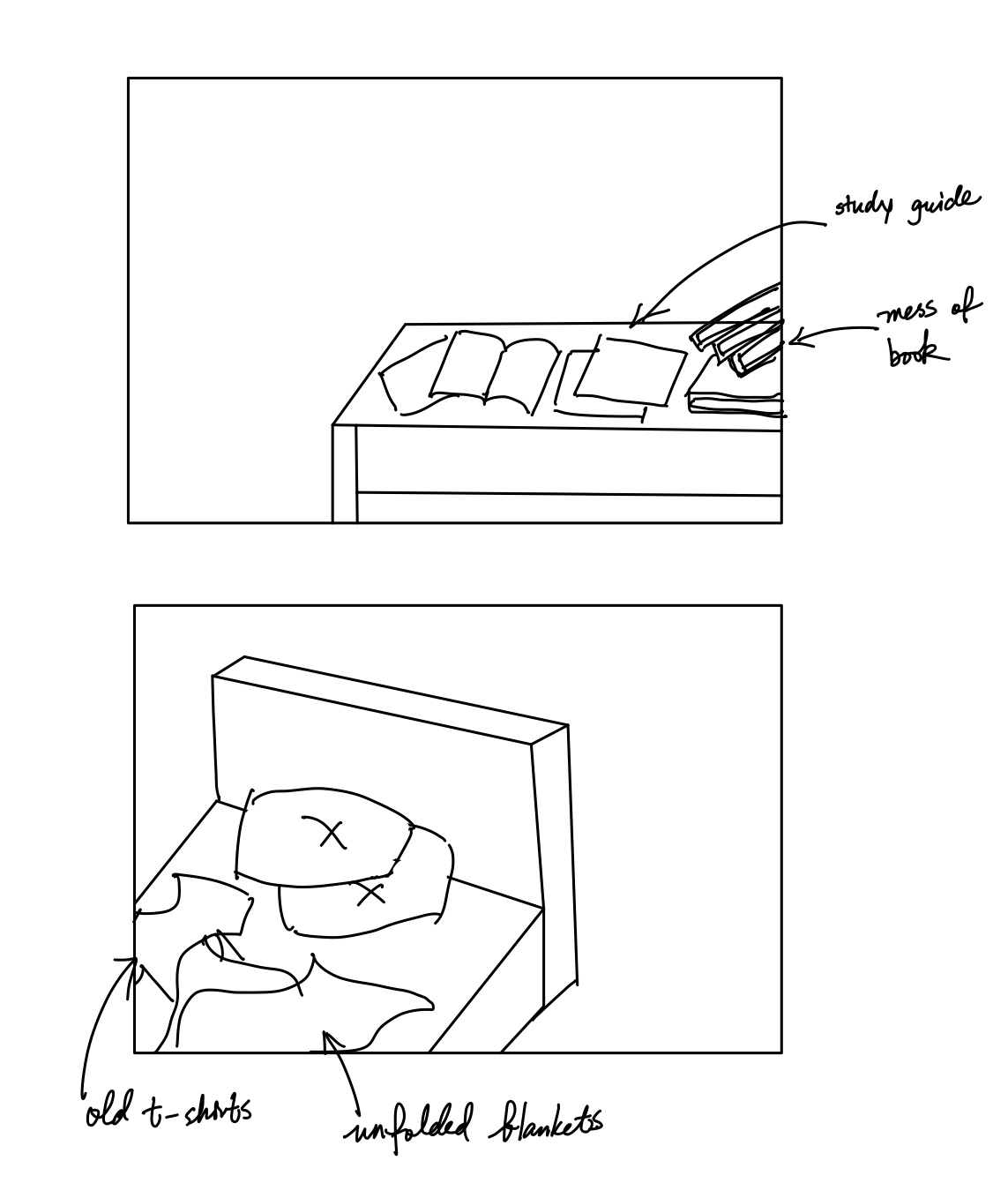
I was working on the storyboard of the video. One of the important parts of the video is the background settings. We want to create an environment to imply the “downtime” theme. Since the video is very short (about one minute and a half), one proper background is necessary. Background settings are the language without any words, but they could carry out some meanings and thoughts.

When people are having downtime, they tend to appear as a tired, despondent image. The first thought comes to mind is to escape home and lay on the bed.  Beds create a comfort zone for individuals; it is warm and soft, like the hug of mom. Most scenes of our video happen on the bed. Laying on the bed also represents the escape from society.

We would like to use the background environment to imply despondent emotion. The mess would be the common way to hint the downtime. There are two major areas in the video: the desk and the bed. Since Alice is still a student, we display the study guides on the desk and cover the surface disorderly. There is an opened book using to tell Alice is now facing some problems caused by school. Unfolded blankets on the bed imply that those problems bother Alice for a long time, that is, she has no extra energy to fold those blankets before going to school. The mess of bed and desk represents the exhaustion in real life, and explain the reason for escaping from real life and hiding into the digital community.

Yining Wang 20614744

Music Selection

The main background music underlying the video is the track “It Catches Up With You”, from the 2010 David Fincher movie “The Social Network”. This is one of my favourite films, despite the large amount of artistic license it takes with Facebook’s origin story and the personality of Mark Zuckerberg, cast here as a social outcast with a lot to prove. I’ve always identified strongly with Mark’s struggle between his loneliness and his loathing of vulnerability. These themes of craving meaningful connection and community were ones that I wanted to also bring to our major video project.

“It Catches Up With You” plays during the scenes where Mark is dealing with the fallout of being socially ostracized for releasing Facesmash, a website designed to empirically rank female students based on their attractiveness by comparing their photos pairwise. Mark had not gotten permissions from the female students to put their photos up, and in any case the website was in extremely poor taste. At this point in the movie, Mark is easily the most hated kid on campus by both staff and students, he’s got a hangover from coding Facesmash while drunk last night, and he’s still trying to grapple with the fact that his longtime girlfriend has broken up with him.

While the scene we’ve chosen to depict in our video project is not nearly as depressing as all of that, I am trying to hint at some kind of stress in the subject of the video, Alice. Clearly, the girl is not happy. Additionally, I like this song for its long drawn out notes and the way that electronic guitar feedback echos in the background. This slows the video down to a pace fitting a depiction of the end of someone’s day, and emphasizes the electronic influences on lives that we’re trying to discuss with this video.

Shooting the Video

The concept of our video was very simple, consisting of essentially only 1 scene in a dimly lit interior room. This made shooting easy, since I didn’t have to juggle locations and I could control lighting very easily. However, I had to pay more attention to continuity than usual because the set is shown from many angles throughout the scene and I had to make sure that in each scene the details like the arrangement of books on the desk, pillows and blanket on the bed, and where the backpack was placed, remained consistent.

The only camera used on the shoot was a OnePlus 6T. This is my personal phone, and it’s a mid-tier Android phone which doesn’t have particularly good camera quality and has no optical image stabilization. This gives most shots a grainy, shaky quality that looks less polished and thus more intimate and authentic, both of which are better for the theme of the video. Furthermore, because of the way that video is edited to long sustained notes in the song, wobbling the camera or changing camera focus gives the viewer something to look at during these still shots.

I included two spiral shots in the shoot, one zooming in and one zooming out at the end of the shot. These are both long shots and are meant to be a visual representation of someone’s life spiraling out of control as well as to build tension in a video that doesn’t have much in the way of a plot.

Alice in X-reality

Our video features a typical university student Alice in a setting where there is a collision between the real world and the virtual world. In the real world, she is immersed in stacks of scholastic readings which undoubtedly will enhance the success in her academic trajectories. It is likely that intellectual achievement is important in her culture. When Alice came home exhausted, she did not talk to anyone, but plunged right into the virtual world of Twitter, where possible relationships with strangers await. I can relate her story to Coleman and Shirky’s concept of “X-Reality” (2011: 19). In Alice’s universe, there is a constant crossing of her reality with her virtual reality. For every virtual reality, there is a reality behind it. Alice’s brought up probably shapes the culture of her reality. This culture continuously traverses to build her virtual reality, her expectation from the digital community. The feedback from her interactions with the digital world in turn impacts her reality. The culture is evolving, with real and virtual realities inter-twined and influencing each other (Coleman and Shirky). Under this environment, the generation of independent, successful, tech savvy university student is nurtured.

The cohorts from this generation, like all human beings, crave for acceptance. According to Bugeja, we all desire to belong somewhere (1). Belonging to the virtual world has its advantage. Alice can close the door to socializing if she chooses to turn off her phone. She can explore intimacy in the virtual world, but retreat to her privacy of the physical world by the flip of a switch. She is in an environment where she can be a loner, yet not alone (Turkle).

The relationship in the virtual world, however, cannot replace the compassion which only human interface can offer, like that of a face-to-face relationship. I can reflect that over 40 years ago I had 3 room-mates while attending the University of Hawaii. We had someone to talk to when we came home. The human interface led to life-long friendships. Next week we will chat via a 4-way Skype video conference, only because face-to-face is no longer feasible for us as we now live in Honolulu, San Jose, Toronto, and Waterloo.

Abbie Ho 20701760

Works Cited

Bugeja, Michael. “The Need to belong.” Interpersonal Divide in the Age of the Machine. University Press, 2018.

Coleman, B., and Clay Shirky. Hello Avatar : Rise of the Networked Generation, MIT Press, 2011. ProQuest Ebook Central, https://ebookcentral.proquest.com/lib/waterloo/detail.action?docID=3339340.

Turkle, Sherry. “Always-on/Always-on-you: The Tethered Self.” Handbook of Mobile Communication Studies. Ed. James E. Katz. Cambridge, MA: MIT Press, 2008.